

Table of Contents
- Why Kids Freeze Up in Front of a Camera
- Games to Get Kids to Smile for Photos
- What to Say to Get Kids to Smile for Pictures
- Tips for Photographing Toddlers
- How to Photograph Shy Children
- When Smile Prompts Fail: A Backup Plan
- Camera and Timing Tips for Natural Smiles
- Conclusion: Let the Smile Come to You
- Frequently Asked Questions
Last Updated: October 15, 2026
Why Kids Freeze Up in Front of a Camera
A camera pointed at a child often produces the same result: a stiff, tight-lipped grimace. That reaction is normal. Kids know when they are being watched, and many read a camera as a test they might fail.
So they freeze. The shoulders rise. The eyes drift away.
Parents feel the pressure too, and children pick up on it fast. The more you ask for a smile, the harder it becomes to get one.
That is why the best photos rarely come from asking. They come from play. This guide from Vickshots covers how to get kids to smile naturally for photos, with the games, phrases, and timing that pull out real laughter, plus what to do when nothing seems to work.
Games to Get Kids to Smile for Photos
Games work better than instructions because they give kids something to do instead of something to perform. Try these:
- Peekaboo: Cover your face, then pop out with a big expression.
- Hide-and-seek: Let them hide behind you, a tree, or a parent.
- Silly races: Count down and have them run toward the camera.
- Tickling: Quick tickle hugs produce instant, genuine laughter.
- Freeze dance: Play a favorite song and stop it at random.
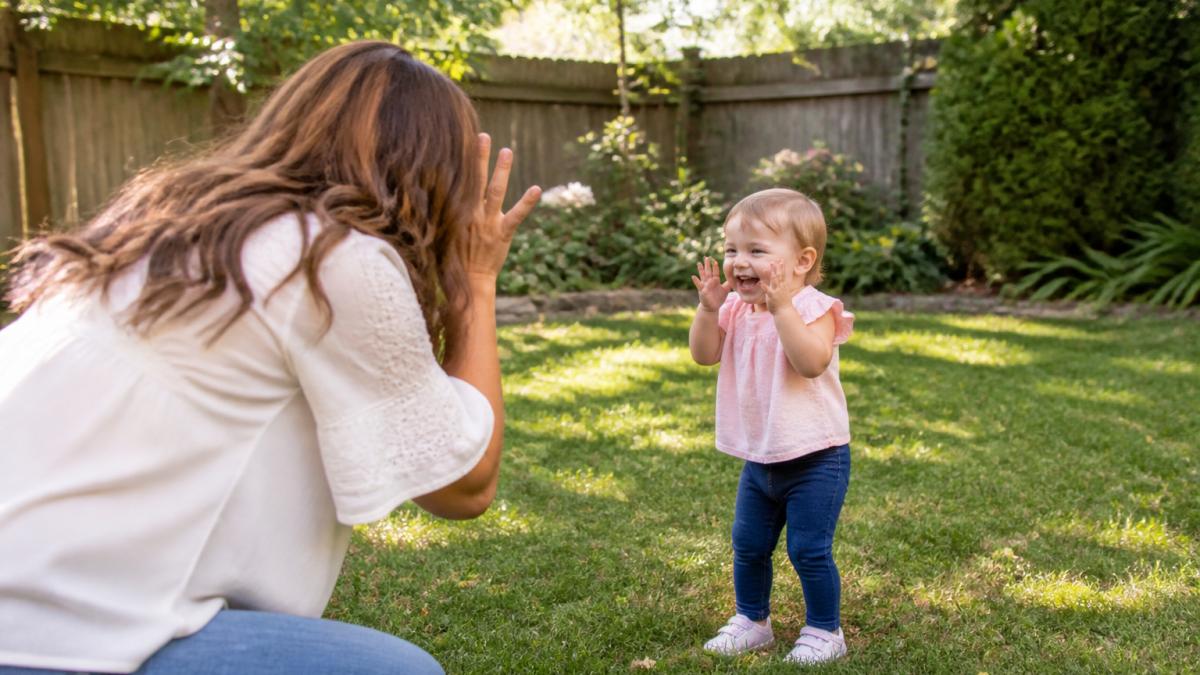
Genuine joy often shines brightest when children feel comfortable in their outfits, making the thoughtful process of styling kids for photos an essential step toward achieving those relaxed and authentic expressions.
The key is motion. A moving child cannot hold a fake grin, so the real one shows up on its own.
What to Say to Get Kids to Smile for Pictures
The right words turn a photo into a joke. Instead of “say cheese,” try these:
- Ask a playful question: “Do you have a pet dinosaur at home?”
- Sing a favorite song with the wrong lyrics on purpose.
- Count wrong: “One, two, five, eleventy…”
- Use reverse psychology: “Whatever you do, don’t smile.”
- Make silly sounds or talk in a funny voice.
Kids love catching adults being wrong. When they correct you, they laugh, and the camera catches it.
Tips for Photographing Toddlers
Toddlers move fast and lose interest faster, so plan around their stage instead of fighting it. But “toddler” covers a wide range, and the technique that works at 9 months will flop at 4 years. Match your approach to the age in front of you.
Babies (0-12 months). They cannot smile on command, so you are not prompting, you are waiting. The reliable triggers are a parent’s face, a familiar voice, and gentle bouncing. Get the camera above your own face so the baby looks toward the lens while reacting to you. Shoot during the calm, alert window after a nap and a feed, not right before one. Expect the real smile in short bursts; keep shooting through the whole interaction.
Toddlers (1-3 years). This is the peekaboo and tickle stage. Sessions should stay short, often under 15 minutes, because attention runs out fast. Follow their lead and shoot where they want to go. Bring a favorite toy or snack as a backup. Get low, at their eye level, for better connection, and take many frames knowing most will miss.
Preschoolers (3-5 years). They can follow a simple game and love being in on the joke. Give them a job, “show me your loudest dinosaur roar,” “find me something red”, and photograph the reaction. This age responds well to counting wrong and to reverse psychology. They also like seeing the back of the camera, which can buy you a few more minutes.
Older kids (6+). They are self-conscious and can smell a fake prompt instantly. Skip baby games and give them a real challenge or a genuine conversation. Ask about something they actually care about, or set up a goofy competition between siblings. Let them review and delete a shot if they want, that control often loosens them up for the next one.
Patience matters more than gear at every age. A child who feels rushed will shut down. One who feels free will forget the camera is there.
How to Photograph Shy Children
Shy children need time, not tricks. Give them space to warm up before you ask for anything.
Start with no camera at all. Let them see the space, meet the photographer, and settle in. Then bring the camera out slowly, and let them look at the screen between shots. Many shy kids relax once they understand what is happening.
- Skip direct eye contact at first. Shoot them playing.
- Use a parent as a safe anchor nearby.
- Never force a pose or a smile.
- Let them hold a small prop or a toy.
The first real smile usually arrives once they stop worrying about the camera. That is the one worth waiting for.
When Smile Prompts Fail: A Backup Plan
Sometimes nothing works. A tired child, a bad mood, or a hungry toddler will not perform, and pushing makes it worse. Work through this flow before you give up on the shot.
Step 1: Diagnose before you react. Ask what is actually wrong. A child who is hungry, overtired, or overstimulated cannot be joked into a smile. Fix the physical need first, a snack, a break, a quiet room, then try again.
Step 2: Match the fix to the problem.
|
Situation |
What to try |
Why it works |
|---|---|---|
|
Child is grumpy |
Pause and take a break |
Resets the mood without pressure |
|
Child won’t look up |
Shoot them looking down or away |
Candid photos still tell the story |
|
Child is overstimulated |
Move to a quiet spot |
Lowers stress and slows things down |
|
Child is shy |
Back off and shoot from a distance |
Removes the feeling of being watched |
|
Child is camera-anxious |
Hand them the camera to explore |
Familiarity replaces fear |
|
Nothing is landing |
Photograph the real moment |
Honest emotion beats a forced grin |
Step 3: Respect the boundary. Some children simply do not want their picture taken, and that is allowed. If a child says no, or turns away, or covers their face, stop. Forcing the shot teaches them that their discomfort does not matter, and the photo you get will show it. A better move is to put the camera down, play with no lens involved, and try again another day.
Step 4: Adapt for sensory needs. Not every child enjoys touch, noise, eye contact, or bright light. If tickling or loud voices upset your child, drop them. Swap physical prompts for quiet ones: a favorite object to hold, a soft song, a calm game with no sudden sounds. Let them choose where to sit and how close to be. A child who feels in control of the situation is far more likely to relax into a real expression.
Step 5: Know when to stop. If you have cycled through the fixes and the mood is still sliding, end the session. A serious face is still a real one. A child studying a leaf, or hugging a parent, makes a photo that lasts longer than any grin, and a child who leaves on a good note will be easier to photograph next time.
Camera and Timing Tips for Natural Smiles
Timing beats technique. The natural smile lasts a split second, so be ready before it happens.
- Shoot in short bursts to catch the in-between frames.
- Use natural light, like open shade or a golden-hour backyard.
- Keep the camera at their eye level.
- Give them something to look at, not just the lens.
- Anticipate the laugh, and press the shutter just before it peaks.
For group and sibling photos, skip the lineup. Put the kids together, start a game, and shoot the chaos. The best sibling shot is often the one where everyone is laughing at the same joke, not staring at the camera.
Conclusion: Let the Smile Come to You
Knowing how to get kids to smile naturally for photos means giving up control. You set the game, the light, and the moment, then you wait. The laugh arrives on its own, and that is the frame worth keeping.
At Vickshots, we build sessions around exactly that. Our relaxed, natural-light outdoor shoots focus on candid, real-life moments instead of staged posing. We take a personalized, no-pressure approach so nervous kids (and nervous parents) can settle in and be themselves. We also offer aerial photography for a different view of your family’s day.
Book a free consultation with Vickshots and let us capture your family’s real story.
Frequently Asked Questions
Is it normal for kids not to smile in photos?
Yes, it is completely normal. Many children feel pressure when a camera appears, and their instinct is to freeze or look away. A posed smile often looks stiff because it is not connected to a real emotion. The best approach is to shift the focus away from the camera and toward play, conversation, or a silly game. When children forget they are being photographed, their faces relax and genuine smiles appear on their own.
What is the tongue trick for smiling in photos?
The tongue trick involves asking a child to press their tongue against the roof of their mouth while smiling. It can help relax the jaw and create a more natural-looking smile for older kids and teens who tend to clench up. For younger children, the trick often works better as a game: ‘Can you hide your tongue behind your teeth and still give me a big grin?’ Keep it light and playful so it does not feel like a demand.
How do you get natural smiles in photos?
Natural smiles come from real reactions, not instructions. Try telling a joke, making a silly sound, or asking a playful question like ‘Does your teddy bear snore at night?’ Give children something to react to instead of asking them to smile. Timing matters too: shoot in short bursts right after the laugh, not seconds later. For shy children, start with a quiet activity and keep the camera low and unobtrusive until they warm up.
What are some fun games to get kids laughing during a photo session?
Games that involve movement and surprise work best. Try a round of hide-and-seek where you pretend not to see them, a silly-face contest, or a singing game where you change the lyrics to a favorite song. For toddlers, peekaboo and tickle games are reliable. For older kids, a challenge like ‘Can you count to ten without laughing?’ often ends in real giggles. The goal is connection, not performance.